






The first principle is that you must not fool yourself, and you are the easiest person to fool.
1
What Does an AI Visibility Audit for Life Sciences Brands Look Like?
An AI visibility audit for life sciences assesses whether AI platforms mention, describe, recommend or cite a company when answering questions about its products, technologies and scientific expertise. It also identifies why a brand may be missing, inaccurately represented or overlooked as a source.
The need to assess this visibility is growing. The American Medical Association’s 2026 survey found that 81% of physicians use AI in their professional practices, up from 38% in 2023. Summarising medical research and standards of care was the most frequently reported use.¹
For pharmaceutical, MedTech and biotech companies, this creates a reason to understand how AI platforms interpret and present their scientific information
2
Why Does AI Visibility Matter for Life Sciences Companies?
Strong Google rankings do not guarantee visibility in AI-generated answers. A traditional SEO audit reviews search performance, technical health and rankings. A life sciences AI visibility audit examines how AI platforms represent a brand: whether it is mentioned, which sources they cite and which competitors appear in relevant answers.
For example, a pharmaceutical company may want to know whether its products appear in answers about a therapeutic area, mechanism of action or clinical evidence. A MedTech manufacturer may assess whether its devices are referenced in answers about procedures, clinical applications or procurement requirements.
An AI brand visibility audit helps identify these gaps. It is a diagnostic exercise, not a guarantee of traffic, leads or brand recommendations.
3
What Does an AI Visibility Audit Include?
A useful life sciences AI visibility audit evaluates four areas.
- Brand Mentions, Citations and Competitors
Check whether the company, its products and relevant scientific experts appear across selected AI platforms. Record whether responses mention the brand, cite its website, reference scientific publications or rely on competitor sources.
A brand mention without a supporting citation is different from an answer that uses the company’s content as evidence. Both are worth tracking.
- Prompt and Topic Coverage
Build prompts around the information needs of different audiences, including HCPs, researchers, laboratory teams, procurement professionals and patients, where relevant.
For example:
- HCPs: What clinical evidence supports the use of [therapy] for [condition]?
- Researchers: Which platforms can measure [biomarker] in plasma or CSF?
- Laboratory teams: What should labs consider when selecting a multiplex proteomics platform?
- MedTech buyers: Which devices are suitable for [procedure or clinical application]?
This helps identify which scientific and commercial topics are well represented and where AI responses rely on competing sources.
- Website Accessibility and Content Readiness
Review whether important pages are crawlable, indexable, easy to navigate and available as readable text. Check internal links and ensure structured data matches the visible page content.
Google confirms that existing SEO fundamentals remain relevant to its AI features. It does not require special AI schema or additional optimisation specifically for AI Overviews and AI Mode.²
For ChatGPT Search, review crawler settings too. OpenAI identifies OAI-SearchBot for search discovery and GPTBot for content that may be used to improve its foundation models. These controls are independent. Allowing search access does not guarantee a citation.³
- Scientific Credibility and Information Quality
Check whether product descriptions, intended uses, indications, technical specifications and scientific claims are clear, consistent, and supported by appropriate evidence.
Review external references such as peer-reviewed publications, conference materials, and credible industry sources. For regulated life sciences categories, scientific accuracy and appropriate qualifications are just as important as visibility.
4
How Do You Conduct a Life Sciences AI Search Assessment?
A repeatable audit can follow five steps:
- Set the scope: Select priority audiences, products, scientific topics, use cases and competitors.
- Build a prompt set: Include questions such as “Which technologies are used for [application]?” and “How does [brand] compare with [competitor] for [use case]?”
- Test selected platforms: Run the same prompts across ChatGPT, Gemini, Perplexity, Claude and Google AI Overviews, where available.
- Track visibility and citations: Record the exact prompt, platform, date, brand mentions, citation sources, factual accuracy and competitor presence. Tools such as AImpact can support this assessment through AI visibility scanning, semantic mapping, and gap analysis. ⁴ ⁵
- Prioritise fixes: Separate technical access issues from content gaps, weak evidence, and inaccurate descriptions. Address access problems and factual errors before prioritising broader content improvements.
A pharmaceutical AI visibility audit may focus on therapeutic areas, mechanisms of action, safety information, and clinical evidence. A MedTech AI visibility audit may examine procedures, device comparisons, clinical evidence, usability and procurement requirements.
A completed audit should produce more than a visibility score. Teams should have a baseline of brand mentions and citations, a competitor comparison, a list of technical and content gaps, and prioritised recommendations identifying what needs to change.
5
What Should Teams Measure?
Track a consistent set of metrics to evaluate AI visibility over time.
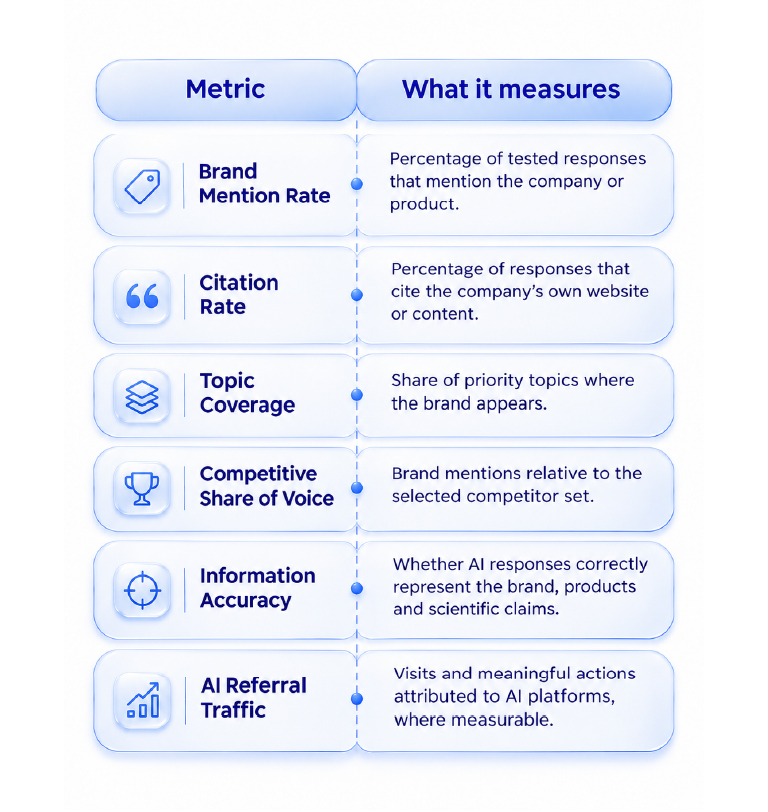
Define the testing conditions consistently. Use the same prompt set, record the platform and date, and repeat priority queries because AI-generated answers can change between runs. Segment results by platform, audience and prompt type rather than relying on one overall visibility score.
6
How Can Life Sciences Brands Act on AI Visibility Audit Findings?
Identifying visibility gaps is only the first step. Companies also need to address the content, scientific communication and technical issues that may prevent their expertise from appearing in AI-generated answers.
This is where AImpact and Ethosh play complementary roles.
AImpact by Ethosh supports the assessment through AI visibility scanning, semantic mapping and gap analysis. It helps life sciences brands understand where their content is referenced, which topics they cover and where competitors have stronger visibility. These insights provide a clearer direction for prioritising improvements.⁴
Ethosh brings life sciences-focused scientific communication, semantic architecture and AI-era digital marketing expertise to the next stage. From developing clear, evidence-led content to improving how scientific information is structured and presented across digital experiences, Ethosh helps companies address the gaps identified during an audit.⁵
Together, AImpact and Ethosh connect visibility assessment with a more structured approach to improving how life sciences expertise is discovered, understood and referenced across AI-driven search experiences.
No platform or agency can guarantee that an AI model will mention or cite a brand. The objective is to make accurate, useful, and credible information easier to discover and understand.
