






Ranking on Google is only half the battle. Your Life Sciences brand also needs to be discoverable, mentioned, and cited when buyers turn to AI for answers.
1
AI Search Engine Optimization: Why Your Life Sciences Brand Ranks on Google but Not ChatGPT
Your life sciences brand can rank on Google and still be missing from ChatGPT’s answers. That’s because AI visibility for life sciences depends on more than traditional search rankings. AI search citations tools retrieve, interpret and select information differently, meaning a strong organic position does not guarantee that your brand or content will be cited.
For pharma, MedTech and LabTech companies, this creates a new discoverability challenge: making complex scientific information easy to find, understand and connect to the questions buyers ask. Improving life sciences with AI visibility requires companies to consider how their expertise appears across both traditional search and AI-generated answers.
2
Why don’t Google rankings guarantee ChatGPT visibility?
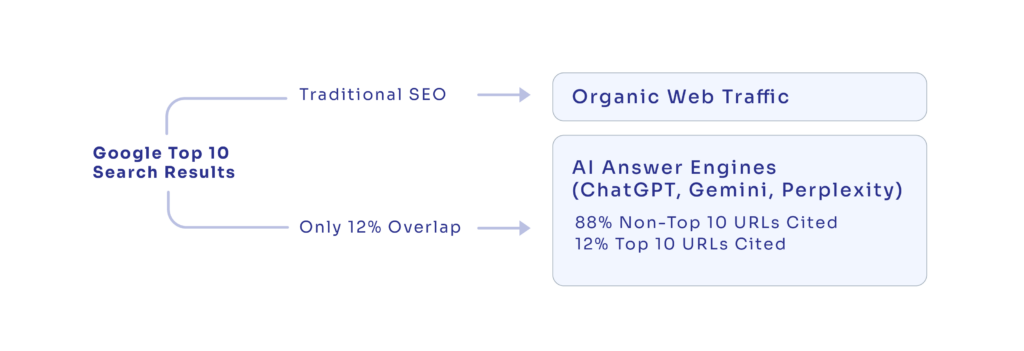
Research from Ahrefs analysed 15,000 prompts across ChatGPT, Gemini, Copilot, and Perplexity. On average, only around 12% of the URLs cited by these AI assistants also appeared in Google’s top 10 results for the same prompt. 1 This is not a life science-specific study, but it illustrates why organic rankings alone are an incomplete measure of AI search visibility.
Google’s AI Overviews behave differently. In separate research, Ahrefs found that approximately 38% of URLs cited in AI Overviews also appeared in Google’s first 10 result blocks. ² the figures are not directly comparable: the studies examined different AI systems and datasets. Their shared lesson is that citation behavior varies by platform.
This distinction matters when defining Answer Engine Optimization (AEO) and Generative Engine Optimization (GEO). Both describe approaches to making information more discoverable and usable in AI-generated answers. For life sciences companies, life sciences AEO, Generative Engine Optimization (GEO) and broader AI search engine optimization should complement traditional SEO rather than replace it. Neither approach guarantees citations, and both depend on the quality, relevance and accessibility of the underlying content.
Google itself states that its existing SEO fundamentals remain relevant to AI Overviews and AI Mode, with no additional technical requirements specifically for inclusion in those features. ³ However, Google’s guidance applies to Google Search not automatically to ChatGPT or every other AI assistant.
3
What might prevent a life sciences brand from appearing in AI answers?
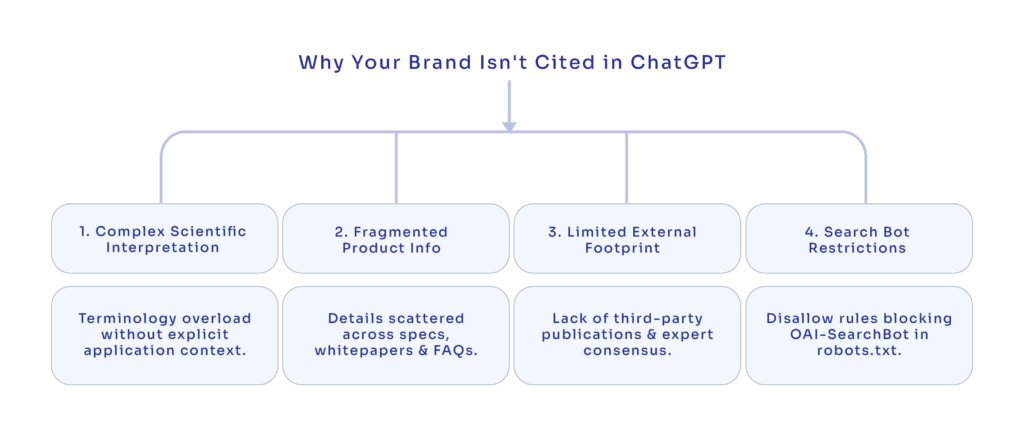
1. Your scientific expertise may be difficult to interpret
Life sciences content often contains specialist terminology, study findings, product specifications, and detailed explanations of mechanisms or workflows. That precision is essential. But if the page does not clearly explain what a product does, who it serves and how it relates to a specific question, the information may be harder for readers and potentially AI retrieval systems to connect to the right query.
For example, a LabTech company may publish detailed assay specifications without clearly explaining which research questions the assay supports, what sample types it is designed for, or how its capabilities differ from alternatives.
The answer is not to oversimplify science. It is to make the scientific relationship explicit: define the application, explain the evidence, clarify limitations, and connect the technical detail to the audience’s information needs.
2. Product information may be fragmented across your website
A product page, technical document, application note, FAQ and thought-leadership article may each explain one part of a solution. If important details are scattered, inconsistently named or missing from the page’s buyers are likely to find, the overall proposition can be harder to understand.
Pharma, MedTech and LabTech teams should check whether their core pages consistently communicate product names, intended applications, differentiators, evidence and relevant limitations. Structured data can help search engines interpret eligible page information, but Google’s guidelines make clear that following structured data requirements does not guarantee a search feature. ⁴ Schema is a support not a substitute for clear, accurate content.
3. Your brand’s expertise may not be visible beyond its own website
A company’s own content is only one part of its digital footprint. Relevant industry publications, expert commentary, partner resources and other credible references may provide additional context about its expertise.
That does not mean every brand needs to chase mentions, or that third-party coverage guarantees AI citations. It means brand visibility should be considered across the information environment in which buyers research products and suppliers not only through rankings on owned pages.
4. Search access may be restricted
There is also a technical issue worth checking. OpenAI distinguishes between OAI-SearchBot, which is used to surface websites in ChatGPT Search, and GPTBot, which is associated with content that may be used to train its foundation models. These crawler permissions are independent. ⁵
A company can therefore make different choices about search access and model training. If appearing in ChatGPT Search is a priority, the relevant crawler configuration should be reviewed rather than assuming that allowing one bot automatically allows the other.
4
Why does AI visibility matter to life sciences brands?
AI-generated summaries can change how people interact with search results. In a Pew Research Center study of 900 US adults’ browsing activity, users clicked a traditional search result in 8% of visits where a Google AI summary appeared, compared with 15% of visits without one.7 The study examined Google searches in March 2025, not ChatGPT use or life sciences buyers, so it should be treated as context rather than a direct forecast for the industry.
A separate 2025 survey reported that AI search was gaining traction while most respondents still preferred traditional search engines for general information.8 Together, these findings support a balanced strategy: retain strong SEO foundations while improving visibility in the AI experiences your audiences use.
5
How to Choose the Right Development Partner
Choosing the right partner requires expertise in scientific communication and interactive learning, not just a strong portfolio.
Look for:
- Experience in pharmaceutical and healthcare projects
- Ability to simplify complex science
- Expertise in 3D medical animation and interactive learning
- Support for SCORM, xAPI, and LMS integration
- Understanding of medical review and compliance
- Experience with global training programs
- Support for future updates and product expansion
A healthcare-focused partner helps ensure scientific accuracy, efficient development, and scalable training.
6
How can life sciences companies improve AI search visibility?
Improving AI search engine optimization for life sciences starts with making scientific expertise clear, accurate and easy to discover. Ethosh combines scientific communication with AI-era digital marketing to help life sciences companies connect complex information with the questions their audiences ask.
For pharma companies: Improve AI visibility for pharma by creating evidence-led content around research, therapeutic areas, mechanisms of action and product questions. Distinguish established evidence from emerging findings.
For MedTech companies: Strengthen AI visibility for MedTech by clearly communicating intended use, capabilities, specifications, differentiators and limitations across product pages and supporting resources.
For LabTech companies: Connect technical specifications with research applications, assay capabilities, sample requirements and relevant use cases.
Across all three sectors, priorities three areas:
- Clear semantic structure: Use descriptive headings, direct answers, and consistent terminology to make complex information easier to understand.
- Evidence and consistency: Support claims with appropriate evidence, keep product information current, and follow Google’s people-first content guidance. ⁶
- Measurement beyond rankings: Track AI citations and brand mentions across platforms alongside organic rankings. Treat results as directional indicators not guaranteed positions.
Google confirms that existing SEO fundamentals remain relevant to AI Overviews and AI Mode, although its guidance does not automatically apply to ChatGPT or other AI assistants ³. Companies therefore need to retain sound SEO practices while evaluating visibility across the specific AI platforms that matter to their audiences.
7
How Does Ethosh Support AI Search Engine Optimization for Life Sciences?
Implementing these priorities requires both digital marketing expertise and an understanding of how scientific information should be communicated and profound knowledge of AI visibility tools. This is where ethosh’s experience at the intersection of scientific communication and digital experiences becomes relevant.
Through its AI-era digital marketing offering, ethosh helps life sciences companies assess how their content is structured, identify information gaps and understand how their brands appear across AI search experiences. Its approach to AI search engine optimization for life sciences includes semantic mapping, visibility analysis and content-gap identification through Aimpact the perfect AI visibility tool. ⁹ These activities can help teams determine where content needs clearer context, stronger connections or more consistent messaging.
The focus is on making scientific expertise more accessible and discoverable without compromising technical accuracy, not promising placement in every AI-generated answer.
8
Conclusion
Google rankings remain valuable, but they tell only part of the story of life sciences brand visibility. As audiences use different platforms to research products and solutions, companies need to understand not just where their pages rank, but whether their expertise appears in relevant AI-generated answers.
Combining strong SEO foundations with clear scientific communication and platform-specific measurement gives life sciences brands a more complete approach to discoverability.
9
References
- Ahrefs. Only 12% of AI-Cited URLs Rank in Google’s Top 10 for the Original Prompt. August 2025.
- Ahrefs. AI Overview Citations and Google’s Top 10.
- Google Search Central. AI Features and Your Website.
- Google Search Central. General Structured Data Guidelines.
- OpenAI. Overview of OpenAI Crawlers.
- Google Search Central. Creating Helpful, Reliable, People-First Content.
- Pew Research Center. Google Users Are Less Likely to Click on Links When an AI Summary Appears in the Results. July 2025.
- Search Engine Land. AI Search Is Gaining Traction, but It Isn’t Replacing Google: Survey. February 2025.
- ethosh. Digital Marketing Built for the AI Search Era.
