






The best scientific content doesn’t start with design. It starts with a brief that gets the science, the audience and the goal right.
1
How to Brief a Scientific Content Agency
You have a medical device to launch, a complex mechanism to explain, or a new technology to introduce. You’ve found a scientific content agency and shared your product information. But when the first draft arrives, the visuals look good while the message feels completely different from what you had in your mind.
What went wrong?
Often, the problem isn’t the content itself. It’s the brief. A clear brief helps the agency understand your science, your audience, and what the finished content needs to achieve. That’s where a clear scientific content brief makes a difference.
2
What Does Briefing a Scientific Content Actually Mean?
Scientific content briefing is the process of explaining your project requirements to an agency before starting the content development. It goes beyond requesting a video, presentation or illustration. Through this briefing you are helping the team or the scientific content agency understand your product, its scientific background, the target audience and the message you want to communicate or pass on.
When working with a scientific communications agency or medical communications agency, the shared brief becomes the starting point for the project. It helps connect your scientific requirements with the creative approach, expected deliverables, and review process.
3
Why Does a Clear Scientific Content Brief Matter?
A brief becomes an important part when your content involves complex scientific information, different teams or multiple approvals. For example, a medical device demonstration video may need to show exactly how the device works and the different parts of the device. While a patient education content needs to explain medical information in simple, easy-to-understand language.
The content to be presented in the deliverables and their level of detailing depends on your audience and the purpose of the content. By sharing these details with the agency before writing, designing or modeling, you actually help the agency understand your expectations and work in the right direction accordingly.
4
Important Things to Include in Your Scientific Content Brief
- Explain Your Goal, Audience, and Expected Outcome
To get desired results, a scientific content brief should start by answering three basic questions: what you want to say, who needs to hear it, and what should they walk away knowing?
A detailed brief at the start can make a huge impact on the project going forward.
An ambiguous brief says- “We need a 60-second 3D animation of our medical device. Make it look great.” Whereas a clear detailed brief says- “We need a 60-second 3D animation for surgeons that demonstrates how our device works during a specific procedure. It should explain in detail the working mechanism of the device and its key features using the given approved references. We will be using it for product demonstrations and different conferences.”
When you define the audience and the core message upfront, the creative team knows exactly what success looks like.
If you want accurate scientific content, you will need reliable and approved information. Depending on your project, you should share:
- Necessary clinical studies, scientific references, approved product claims and key messages required for writers or respective Subject Matter Experts.
- Product instructions, technical specifications, 3D models, CAD files, and product drawings needed for animators and designers.
- And existing videos, presentations, and brand guidelines
A medical writing agency lives on clinical papers and approved messaging, while an animation studio can’t touch a project without physical product specs and 3D assets.
- Define Project Deliverables, Timelines, Budget, and Responsibilities
Make sure that you clearly mention what are your requirements are and whether the expected deliverable should be a scientific illustration, a explainer video, a presentation, a training module, or an interactive experience.
Life sciences content agencies offer different services, but your brief should strictly focus on what your project actually needs.
Explain the required file format, duration or video length, language, deadline, budget, and number of revisions and the specific people who hold final sign-off or approval authority.
5
What Should You Include in Your Scientific Content Brief? A Quick Checklist
Before approaching a scientific content creation agency, check whether your brief answers these questions.
- What is the main goal of this project?
- Who is actually going to see or use it?
- What’s the main thing people should walk away remembering?
- Which approved studies and product claims are to be used?
- What requires verification or double check and what must not be claimed?
- What should be the language and duration of the deliverable?
- Where and how will these deliverables be displayed or used?
- What are the expected milestones, budget and deadlines?
- Who has the final sign-off on the content?
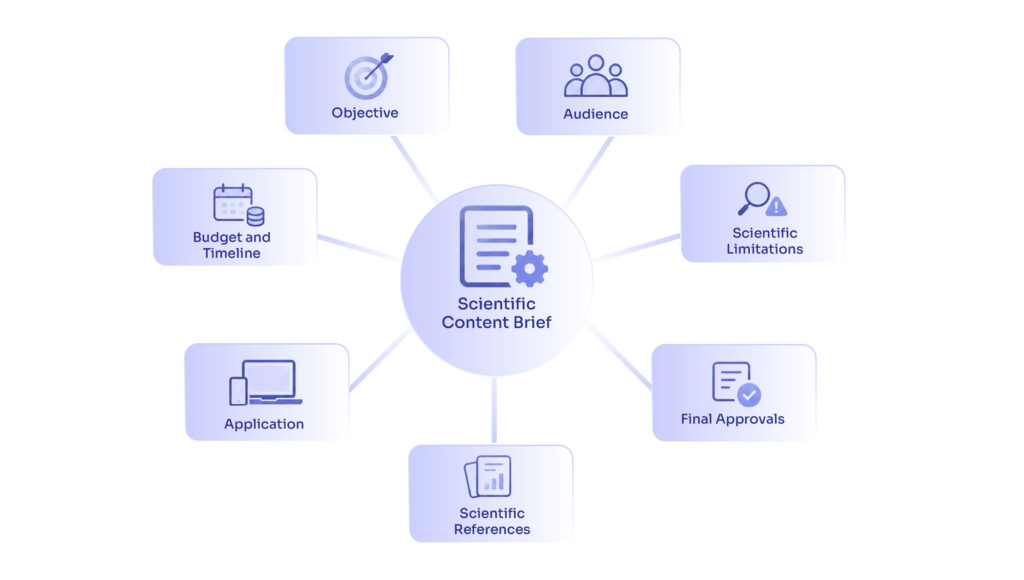
You don’t need every creative detail finalized before contacting an agency. But answering these questions gives the team a stronger starting point and helps identify missing information before production begins.
6
Why Work with Ethosh for Scientific Content?
When comparing top medical communication agencies, top medical communication companies, don’t stop at the portfolio. Look for a team that can understand science, ask the right questions, and translate technical information into content suited to the audience.
At Ethosh, scientific briefing helps in the development of content and visual experiences for Pharma, MedTech, and life sciences audiences. The discussion begins with understanding the product, available supporting evidence, the targeted audience, and the key communication objective. Later, the focus moves toward identifying an appropriate content approach, whether that’s a medical illustration, 3D animation, product demonstration, or interactive experience.
With a well-defined brief, the agency should be able to work with technical information, understand the communication requirements, and recognize the scientific clarifications to establish a clear direction before development begins.
7
A Clear Brief Is the First Step Toward Better Content
You don’t need a finished script or storyboard before contacting a scientific content creation agency. You need clarity about your objective, audience, scientific references, deliverables, and approval requirements. A well-written detailed brief helps everyone to be on the same page, identify scientific and technical questions early, and establishes a clearer and solid direction for content development right from the start.
Planning your next scientific or medical communication project? Reach out to Ethosh and explore the right content approach for your audience.
8
References
- Riggi M, Torrez RM, Iwasa JH. 3D animation as a tool for integrative modeling of dynamic molecular mechanisms. Structure. 2024;32(2):122–130.
- Centers for Disease Control and Prevention. CDC Clear Communication Index: A Tool for Developing and Assessing CDC Public Communication Products. User Guide. August 2019. https://www.cdc.gov/ccindex/tool/
- Chen J, Ma J, Huai Y. Qualitative studies: Designing a multimodal medical visualization tool for helping patients interpret 3D medical images. Front Physiol. 2025; 16:1559801. https://doi.org/10.3389/fphys.2025.1559801
- Google Search Central. General Structured Data Guidelines.
- U.S. Food and Drug Administration. Medical Product Communications That Are Consistent With the FDA-Required Labeling: Questions and Answers. Guidance for Industry. June 2018. https://www.fda.gov/regulatory-information/search-fda-guidance-documents/medical-product-communications-are-consistent-fda-required-labeling-questions-and-answers
- TB Alert India. Request for Proposal: Hiring of a Filmmaking Agency / Filmmaker / Video Editor to Document, Edit, and Produce a Film on the Take Charge Against TB –Phase 2 Project. September 2025. https://tbalertindia.org/wp-content/uploads/2025/09/TBAI-RFP_Hiring-an-agency-for-documentation.pdf
